TRUMP TRACKER
New administration upends U.S. science
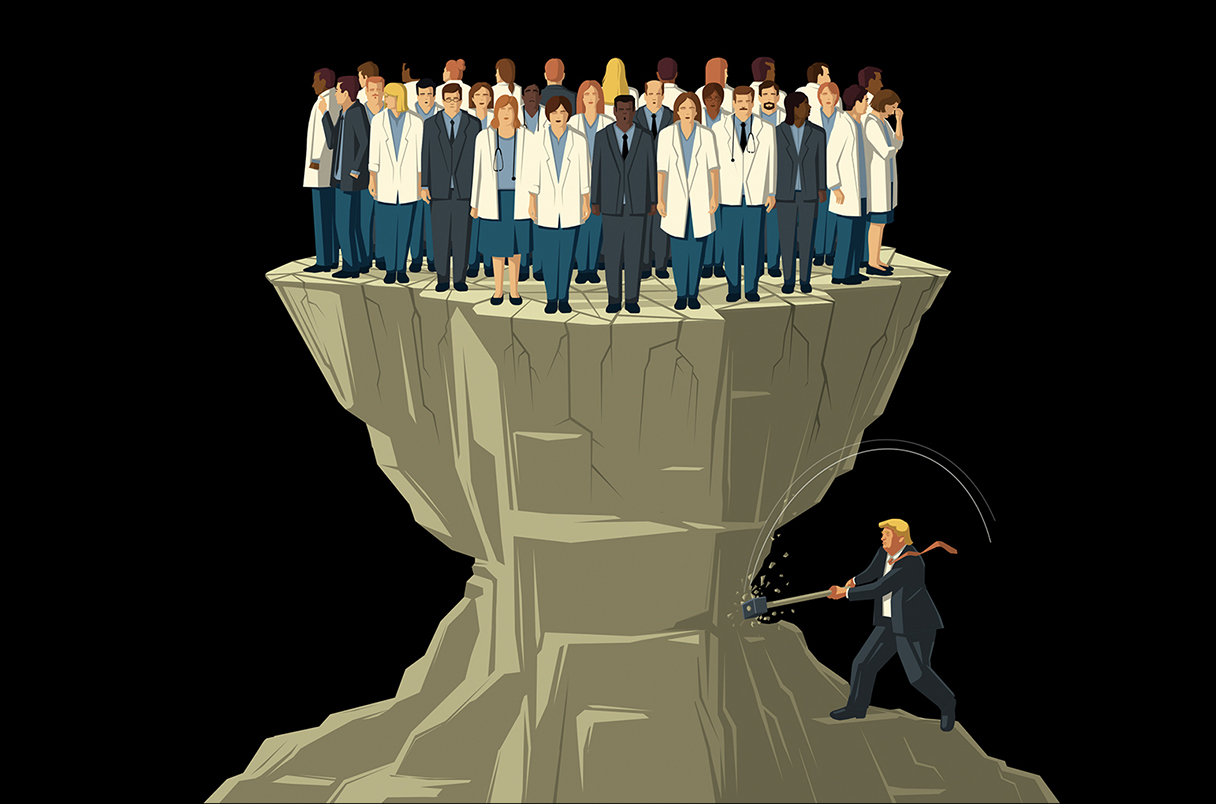
Following through on his vows to shake up the U.S. government, President Donald Trump’s new administration quickly issued a flurry of executive orders and other decisions, some with big implications for research and global health, sowing worry and confusion among many scientists.
GRANTS ROLLER COASTER
The White House this week proposed—and 2 days later rescinded—an unprecedented order to freeze huge chunks of federal spending, including research grants. The 27 January budget memo directed political appointees at every agency to decide whether the funds “conform with administrative priorities” as spelled out in a slew of executive orders Trump has issued since taking office. Despite withdrawing the memo, the White House said agencies must still comply with the executive orders, which ban support for programs that include promoting “Marxist equity, transgenderism, and Green New Deal social engineering policies.” A federal judge had already temporarily halted implementation of the memo, which generated a public outcry. Critics say any effort to take funding decisions out of the hands of peer-reviewed panels overseen by career employees risks politicizing science. “It is hard to see how this [policy would not have ground] biomedical research to a halt very quickly … given the sheer numbers of NIH [National Institutes of Health] grants potentially affected,” says Carrie Wolinetz, a former NIH official who is now a lobbyist.
Editor’s note: This item has been updated with developments that occurred after a version of this article in this week’s print issue of Science went to press.
A separate executive order prohibits the use of “gender” in government publications, potentially interfering with many research grants. It inaccurately defines gender as a male-female binary and states that gender identity has no basis in “biological reality.” The order also bans the funding of grants that “promote gender ideology.” Researchers who have NIH grants to study health in people who identify as neither male nor female say they are fearful such grants would be permanently canceled. Science identified at least 400 of these grants totaling $235 million, funded by almost every NIH institute. Nearly half involve HIV/AIDS, and many are focused on transgender youth (see related story).
Another order ended government programs promoting diversity, equity, and inclusion (DEI), signaling the demise of long-running university projects designed to broaden the scientific workforce by recruiting underrepresented minorities. Several U.S. research agencies quickly canceled existing grant programs and solicitations for future awards. The terminations will extend beyond racial distinctions, as DEI programs also support researchers who are disabled or come from economically disadvantaged backgrounds. Trump’s order calls DEI efforts “illegal and immoral discrimination programs.” Some scientists told Science they plan to continue the work without using DEI terminology to try to skirt the crackdown—even as the government has asked whistleblowers to report such attempts.
Last week the administration halted external communications, travel, purchasing, and new experiments by NIH employees, to enable a review. Past presidents have made some similar restrictions. But the breadth of those under Trump, which included meeting cancellations, bewildered researchers who said they could stall in-house research and clinical trials at the $47.4 billion biomedical agency and impede its administration of external grants. Days later, on 27 January, newly appointed acting Director Matthew Memoli, a longtime influenza researcher at NIH, issued a memo describing circumstances under which NIH would make exceptions during this “pause,” which will allow “the new team to set up a process for review and prioritization.”
Another executive order nullified former President Joe Biden’s blueprint, issued in October 2023, to foster the use of safe, secure, and trustworthy artificial intelligence. Echoing criticisms by technology industry leaders of the Biden administration plan, Trump’s order asserts it would have “hindered innovation and imposed onerous and unnecessary government control.” Trump has asked aides for a new plan within 180 days that would promote economic competitiveness and national security and sustain U.S. leadership in the field.
Trump’s administration paused all foreign assistance pending an 85-day review, an edict that could disrupt the ability of a key U.S.-funded program to provide lifesaving anti-HIV drugs on a timely basis to 21 million people in 55 countries. The President’s Emergency Plan for AIDS Relief uses contractors based in the United States and other nations to distribute money.
POLICY
New Zealand’s research community is cautiously welcoming a major shake-up of the country’s science infrastructure meant to promote economic growth. Among the changes, announced last week by the government, the biggest will consolidate the country’s seven Crown Research Institutes. Starting later this year, the institutes will be reorganized into three new “public research organizations” focused on earth sciences, biological sciences, and health and forensic sciences, respectively. A fourth, new entity will concentrate on developing artificial intelligence, quantum computing, and synthetic biology, among other technologies. All will seek increased investments from the private sector; another new agency, Invest New Zealand, will work to tap foreign investment for this research. Some scientists worry the plan lacks adequate government funding, will create unreasonable expectations for fast economic returns, and will spur additional job losses in the research sector. In 2024, several Crown Research Institutes laid off hundreds of staff members.
ECOLOGY

Cutting grass in curves—rather than straight lines—and varying their paths over time benefit pollinators, a study has found. Industrial agriculture makes meadows less welcoming to insects, in part because most fields are mowed completely all at once, lessening their habitat diversity. Mowing just part of a field at a time can help a lot, but how it’s done matters, a research team discovered. During 3 years of experiments, farmers cut sinuous shapes across some fields twice per year, each time keeping a two-to-one ratio of mown to unmown areas. The diversity of butterflies and bees was up to 30% and 40% higher, respectively, in those fields than in ones in which grass was mowed in straight lines and the two-to-one ratio was maintained. The curvy method requires more training, time, and effort for farmers. It could also benefit urban parks and even small residential yards, the team reported last week in Agriculture, Ecosystems & Environment.
WORKPLACE
Rena D’Souza, the embattled director of the dental research institute at the U.S. National Institutes of Health (NIH), will retire as of 31 January, the agency told employees in an email last week. NIH placed D’Souza on paid administrative leave in April 2024 during a probe of her workplace behavior as head of the $520 million National Institute of Dental and Craniofacial Research. She had sued the secretary of the Department of Health and Human Services (HHS), NIH’s parent department, in 2023, alleging race, sex, color, and national-origin discrimination after NIH placed her on two shorter, unpaid leaves. D’Souza said both the lawsuit and HHS proceedings against her ended last week when she and the agency signed a settlement agreement with undisclosed terms. D’Souza, 70, was born in India and in 2020 became was the first woman of color to direct an NIH institute.
LEGAL AFFAIRS
A U.S. judge in Minnesota this month tossed expert testimony by a researcher who specializes in artificial intelligence after he submitted a statement containing two references, generated by AI, to nonexistent papers. According to the ruling, Jeff Hancock of Stanford University admitted the bogus references resulted from using GPT-4o to prepare his testimony, which discussed the hazards to democracy posed by AI-generated content. Minnesota’s attorney general had tapped Hancock to help defend a state law that bans using AI-generated “deepfake” content to damage a political candidate. In her order excluding Hancock’s testimony, District Court Judge Laura Provinzino wrote, “The irony. Professor Hancock, a credentialed expert on the dangers of AI and misinformation, has fallen victim to the siren call of relying too heavily on AI—in a case that revolves around the dangers of AI, no less.”