Scientists with the USGS and Michigan State University, funded by the Great Lakes Fishery Commission, found that slower sea lamprey growth rates during the larval phase of development may increase the odds of sea lampreys becoming male. During the study, environments lacking plentiful food were male-skewed, with 78 percent of sea lampreys becoming male after three years, whereas environments more conducive to growth produced only 56 percent males.
This discovery could be a critical step in developing advanced technologies to control sea lamprey.
“Remarkably, we didn’t set out to study sex determination in sea lampreys – we were planning to study environmental effects on growth rates only,” said Nick Johnson, a USGS scientist and the lead author of the study. “We were startled when we discovered that these data may also reveal how sex is determined because mechanisms of sex determination in lamprey are considered a holy grail for researchers.”
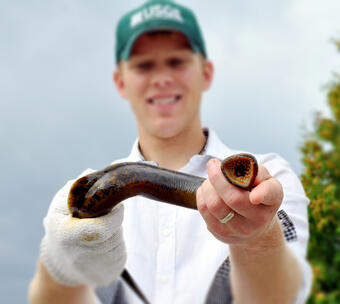
Sea lampreys are imperiled in Europe and the Pacific Northwest, where they are native, but are invasive and destructive in the North American Great Lakes. With their blood-sucking capability and gaping round mouths, sea lampreys feed on the blood and fluids of native fish, causing population declines in commercially and recreationally important species that are essential to the Great Lakes’ multi-billion dollar per year fishery.
Between 2005 and 2007, the scientists tagged and released sea lamprey larvae into unproductive lakes and productive streams. These environments included tributaries of Lakes Huron and Michigan and areas of those lakes near stream mouths. The researchers then recaptured the tagged fish as adults during their spawning migrations.
The sex ratios in productive and unproductive environments were initially similar but quickly diverged, with unproductive lakes becoming increasingly male-dominated. Once the larvae changed into their parasitic adult stage, their sex did not shift, and their survival rates generally did not differ between productive versus unproductive environments.

“The results of this study could be a critical step toward developing advanced technologies to control sea lampreys in the Great Lakes, which have caused unparalleled damage to fisheries,” said David Ullrich, chair of the GLFC. “Although sea lamprey populations have been reduced by 90 percent, innovation will be key to maintaining strong control into the future. The results of this study could open paths forward to novel technologies that can disrupt or modify gender in sea lampreys, providing the commission with other means to control this noxious predator.”