Here, methane and the bacteria that feed off it form the lynchpin of an ecosystem that is similar to what has been found in deep ocean cold seeps and some lakes, according to recent research by Texas A&M University at Galveston, the U.S. Geological Survey and a team of collaborators from Mexico, The Netherlands, Switzerland and other U.S. institutions.
The research, conducted by scientists who are trained in cave diving in addition to their other expertise, is the most detailed ecological study ever for a coastal cave ecosystem that is always underwater. In fact, the scientists had to use techniques that had previously been used by deep-sea submergence vehicles to be able to study the environment.
“The opportunity to work with an international team of experts has been a remarkable experience for me,” said David Brankovits, who is the paper’s lead author and conducted the research during his Ph.D. studies at TAMUG. “Finding that methane and other forms of mostly invisible dissolved organic matter are the foundation of the food web in these caves explains why cave-adapted animals are able to thrive in the water column in a habitat without visible evidence of food.”
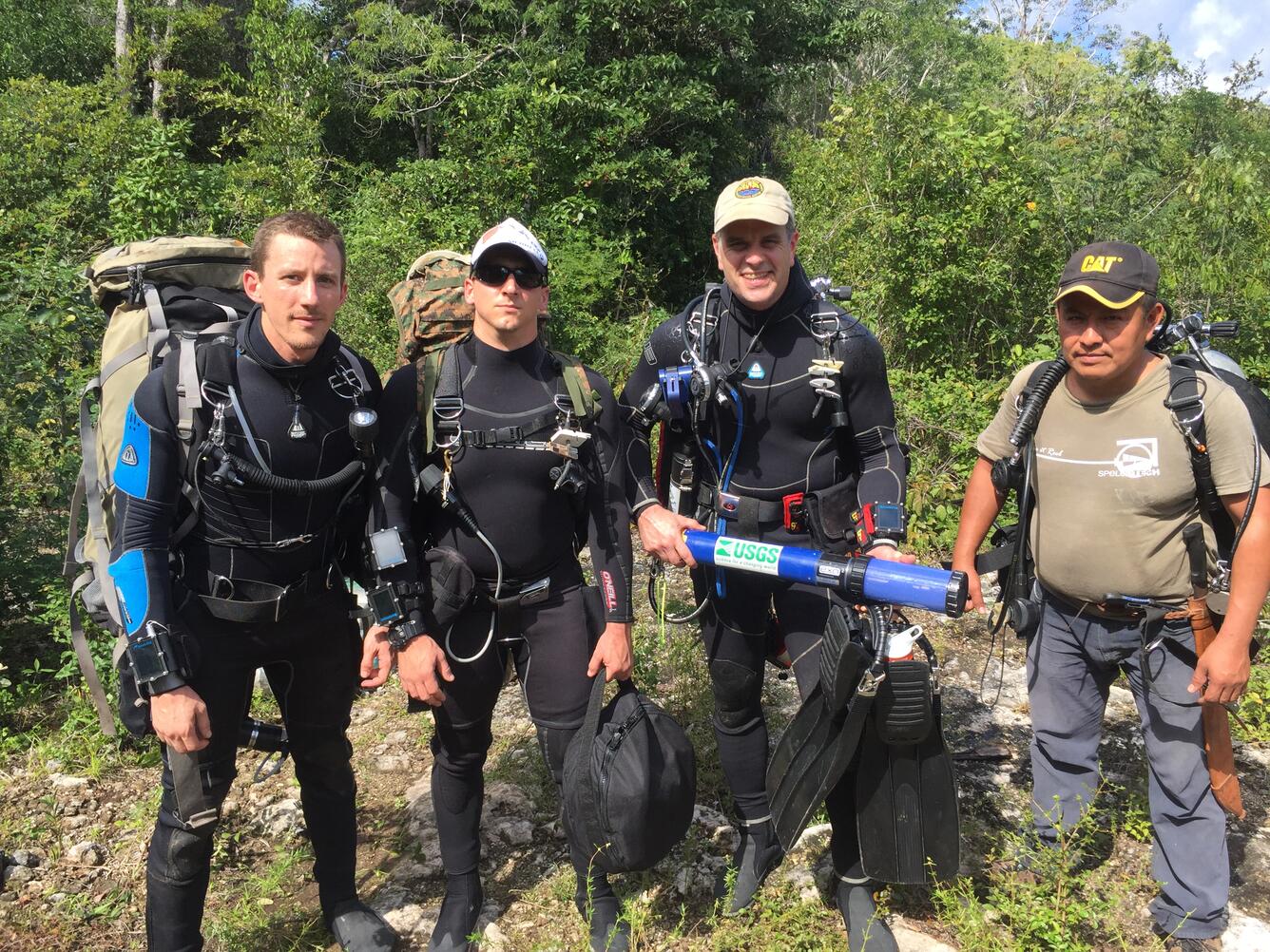
Ox Bel Ha Cave Project Field Team Members (left to right) David Brankovits (TAMUG), Jake Emmert (Moody Gardens), John Pohlman (USGS), and Francisco Bautista De La Cruz (Speleotech). (Credit: Jacob Pohlman. Public domain.)
The study was conducted in the Ox Bel Ha cave network of the northeastern Yucatan, which is described as a subterranean estuary because the flooded cave passages contain distinct water layers consisting of freshwater fed by rainfall and salt water from the coastal ocean. This subterranean estuary complex covers an area approximately the size of Galveston Bay, the seventh largest surface estuary in the United States.
The freshwater portion of the caves and the sinkholes, which are used to access the caves and are referred to locally as cenotes, are important sources of freshwater for communities throughout the Yucatan. Methane in the caves forms naturally beneath the jungle floor and migrates downward, deeper into the water and caves. Normally, all of the methane formed in soils migrates upward, towards the atmosphere.
This sets the stage for the bacteria and other microbes that form the basis for the cave ecosystem. The microbes eat both the methane in the water and other dissolved organic material that the freshwater brought with it from the surface. The microbes then fuel a food web that is dominated by crustaceans, including a cave-adapted shrimp species that obtains about 21 percent of its nutrition from methan