According to a new study published in Science Advances, scientists found that such flooding not only will impact terrestrial infrastructure and habitats, but, more importantly, it will also make the limited freshwater resources non-potable and, therefore, directly threaten the sustainability of human populations.
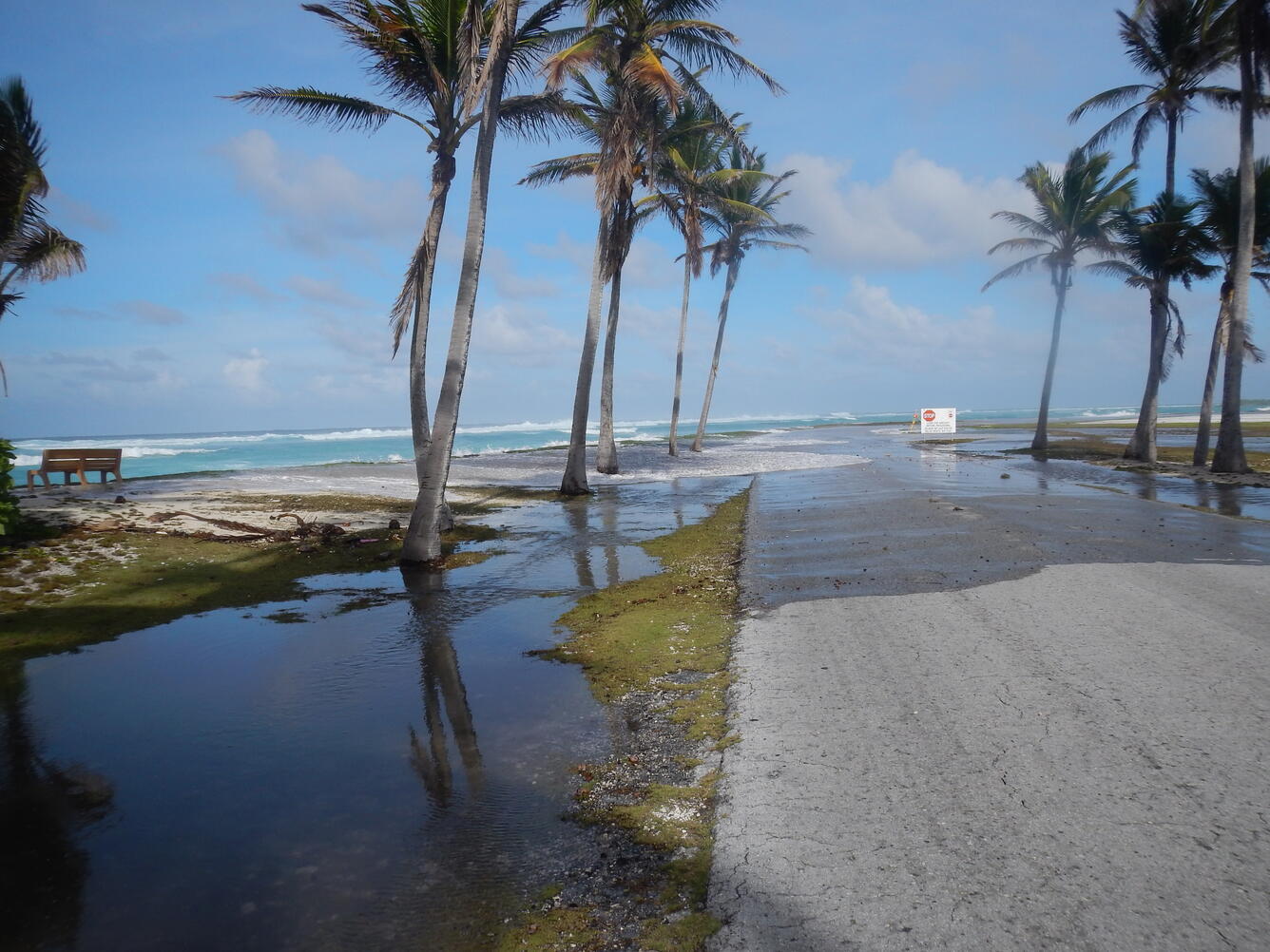
Most of the world’s atolls are in the Pacific and Indian oceans. The scientists focused on Roi-Namur Island on Kwajalein Atoll in the Republic of the Marshall Islands for their site study from November 2013 to May 2015. The Republic of the Marshall Islands has more than 1,100 low-lying islands on 29 atolls, is home for numerous island nations and hundreds of thousands of people.
Scientists from the U.S. Geological Survey, Deltares, National Oceanic and Atmospheric Administration, and the University of Hawaiʻi at Mānoa used a variety of climate-change scenarios to project the impact of sea-level rise and wave-driven flooding on atoll infrastructure and freshwater availability. The approach and findings in this study can serve as a proxy for atolls around the world, most of which have a similar morphology and structure, including, on average, even lower land elevations.
“The tipping point when potable groundwater on the majority of atoll islands will be unavailable is projected to be reached no later than the middle of the 21st century,” said Curt Storlazzi, USGS geologist and lead author of the new report.
Sea levels are rising, with the highest rates in the tropics, where thousands of low-lying coral atoll islands are located. Previous studies on the resilience of these islands to sea-level rise projected they will experience minimal inundation impacts until at least the end of the 21st century. However, those previous studies did not take into account the additional hazard of wave-driven overwash (storm waters and waves that wash up and over the low-lying island) nor its impact on freshwater availability.
“Such information is key to assess multiple hazards and prioritize efforts to reduce risk and increase the resiliency of atoll islands' communities around the globe,” said Storlazzi.
These findings have relevance not only to populated atoll islands in the Marshall Islands, but also to those in the Caroline Islands, Cook Islands, Gilbert Islands, Line Islands, Society Islands, Spratly Islands, Maldives, Seychelles, and Northwestern Hawaiian Islands.